Research · Working with AI agents
I want my AI tools to talk to each other
I wanted less copying between agents. We’ve built the mailbox; some handoffs still need work.
AI tools helped draft and edit this article. I commissioned the project; coding agents carried out the implementation and testing described.
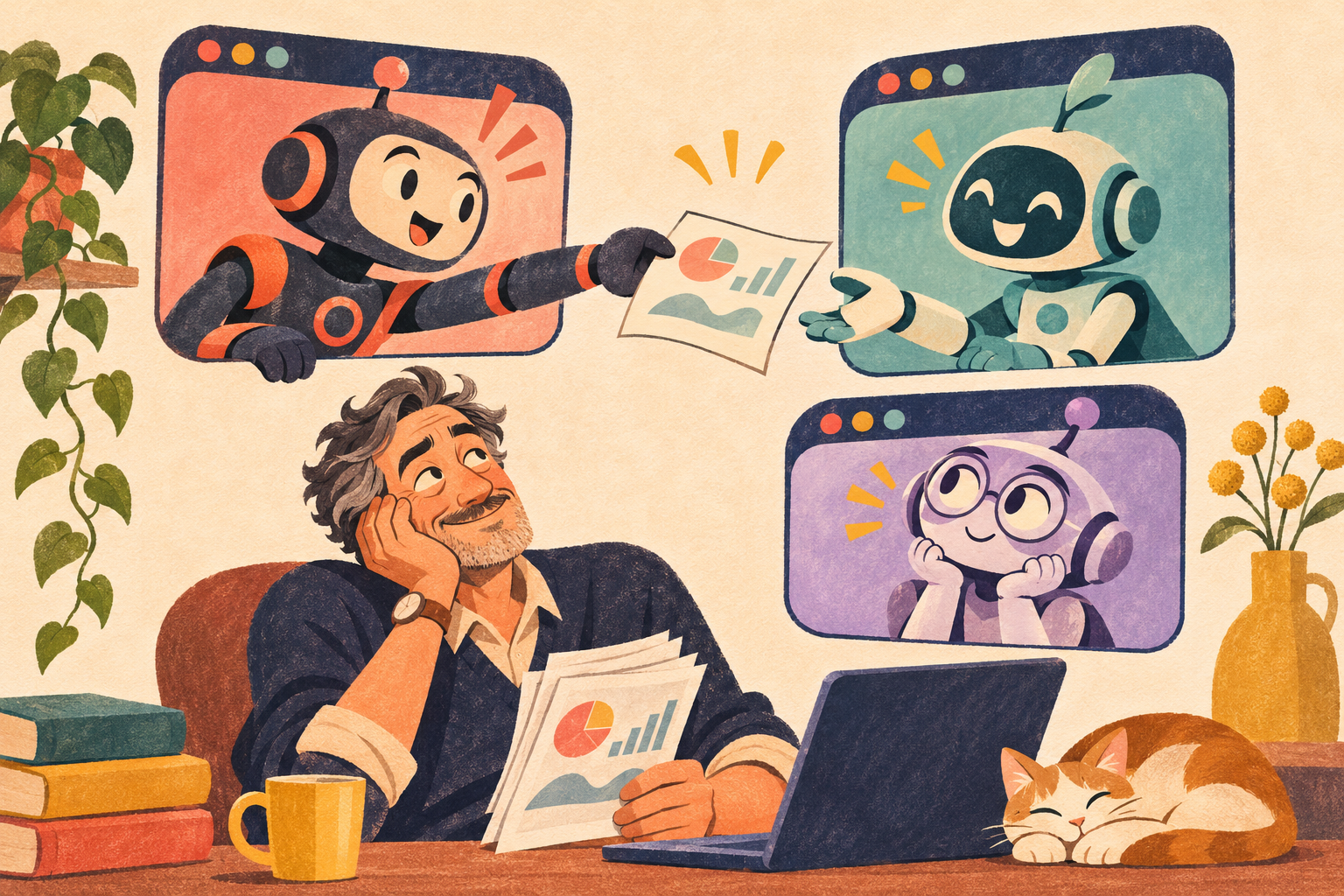
I wanted my AI tools to talk to one another because I was spending too much time carrying work between them. One writes a draft, another builds the report and a third checks it. Then I end up passing the findings back.
I’m building a working environment for the research behind X-Trillion, our fixed-income research tools, bringing together Claude, Codex, Grok, Gemini Carbon, Kimi and DeepSeek in cmux lanes. Each lane holds an agent session working on a particular project or task. I wanted those agents to find one another, pass work between them and bring me back a result I could assess.
The central part is now built: an internal mailbox where agents can leave addressed requests and replies. I set the goals and decide what is ready to use. Coding agents build and test the connections; coordinator agents keep track of the work.
What we have now
The mailbox stores the substance of a request. A coordinator can leave a brief for a worker, with the relevant report, file version and question. On a connected route, the worker receives a short pointer to that message, reads it and leaves a reply.
The work also has a record outside any one conversation. If my MacBook reboots, the saved messages, briefs and checkpoints are still there. An agent can pick up from that record without me explaining the whole job again.
That preserves the saved task context. Getting every agent to restart and resume automatically is a separate part of the work.
It also reduces the amount of text passed between assistants. A worker fixing a chart needs the report, the page and the fault. It does not need every earlier exchange about the report. Reading the brief still uses tokens, but the rest of another agent’s chat can stay out of its context window.
Why I use Grok Bot
My work involves research, reports and presentations. A draft still needs the right figures, readable charts and a check before I use it.
Grok Bot is a ready-made AI agent with access to a cloud computer, so it can work across apps and websites. I use it for research and writing jobs.
The awkward part comes when its output needs to go somewhere else. A draft has to reach the report software. A review has to get back to the author. I want the agents to handle those handoffs instead of leaving me to join them up.
A quick guide to the names
A coding agent can read and edit project files and run tests, within the access it has been given. A coordinator is another AI agent, responsible for assigning work and checking what comes back.
cmux is the Mac application where I keep these sessions organised. Each workspace, or lane, holds a project or job, with its text terminal and browser views. It lets me see several agents working alongside one another.
T3 Code is an interface for working with coding agents. It gives me a conversation and access to the project’s files. Some agents run on my MacBook, others on a Mac mini or a rented Hetzner server. T3 lets me work with the remote sessions from my Mac, and I keep those views open inside cmux.
Putting two sessions next to each other does not make them talk. The mailbox, directory and delivery code provide that connection. They exist already; we’re checking the routes into each agent rather than assuming a name in the directory means it is reachable.
One report, several jobs
For a country research report, a correction can now be recorded as a message tied to the relevant file. If a reviewer spots a chart across a page break, the request can name the exact PDF and page instead of relying on me to explain the problem again.
The builder’s job is to correct the layout and return a rebuilt PDF. The coordinator checks the pages and reports what changed; I read the result and decide whether to accept it. A paragraph needing a rewrite belongs with the author instead.
The mailbox gives those handoffs somewhere to live. Getting each agent to pick up its request and carry the next step through reliably is the part still being finished.
A handoff I didn’t have to arrange
I asked the Codex coordinator to investigate the missing replies with the Carbon agent. Carbon returned a proposed repair. The coordinator checked it, found a timeout case that could send the same message twice, and sent it back. Carbon corrected it; the coordinator reran the checks.
The coordinator then passed the reviewed repair to Fable, another coordinator agent responsible for integrating the messaging changes. I hadn’t named Fable in my request. The existing ownership records supplied that part of the handoff. Fable confirmed responsibility but stopped short of installation: the publication and deployment holds were still open. The agents had carried the work further without me forwarding each message, while keeping clear what remained undone.
What is still unfinished
Grok Bot’s message had reached Fable’s mailbox. It hadn’t woken Fable to read and act on it. The mailbox had done its part; the notification had not. The technical article follows the investigation and the exchange that came next.
Once the coordinator brought the request into the agent’s session, the exchange continued. That is useful progress, even though the automatic wake-up still needs work. A report still needs my approval before publication.
The time has to come back to me
Anyone using several AI tools may recognise the extra admin. Research moves into a document; analysis becomes a spreadsheet or presentation. There is still a person making sure the pieces meet.
For me, the practical test is the research work behind X-Trillion. Can the agents produce a report I can assess, without making me carry it between them?
We have moved beyond passing everything through my conversations: there is now a mailbox, a directory and a record of the work. Making sure an arriving message reliably wakes the right agent is the next part of the project, and the subject of a follow-up. My test remains whether these connections give me back more time than they take to supervise. I’d like to spend that time reading the research.